03 March 2018

Cassette tape measurements: Maxell XLII-S, Hitachi SX


This is the second part of my cassette characterisation effort, now for the various generations of Maxell XLII-S, using a Nakamichi BX-300 recorder.

For the full introduction and a description of the method please go here.

Click on the graphs for a larger version.


INDEX OF ALL CASSETTES

Maxell XLII (1994)(my calibration reference)

Relative bias: (reference)
Relative sensitivity: (reference)
THD @ Dolby level: 0.62%
MOL400(THD=1%) : +1.8dB
MOL400(THD=3%): +5.3dB
MOL1k(THD=3%): +5.5dB
SOL10k: -3.4dB
Bias noise: -54.8dB, -59.2dB(A)
Dynamic range: 64.5dB

I repeat here the results for the tape my Nak BX-300 is calibrated for in type II position, the 1994 XLII. All following XLII-S results take this as reference.


Maxell XLII-S (1980)

Relative bias: -1.5
Relative sensitivity: +1.0dB
THD @ Dolby level: 0.82%
MOL400(1%) : +1.0dB
MOL400(3%): +5.2dB
MOL1k(3%): +5.1dB
SOL10k: -2.4dB
Bias noise: -50.7dB, -54.0dB(A)
Dynamic range: 59.2dB

The very first XLII-S, and the prettiest. MOL is better than UDXLII, but noise is higher. Still, in overall dynamic range XLII-S wins. SOL is remarkably good.


Maxell XLII-S (1982)

Relative bias: -4
Relative sensitivity: +2.5dB
THD @ Dolby level: 0.70%
MOL400(1%) : +1.4dB
MOL400(3%): +5.2dB
MOL1k(3%): +2.7dB
SOL10k: -4.5dB
Bias noise: -53.2dB, -57.0dB(A)
Dynamic range: 62.2dB

A massive improvement in noise, at the cost of SOL, and a totally different alignment. Note the low bias. When I tried this tape in my Cassette Deck 1 I could not even get a flat response with the front-panel Fine Bias knob. Luckily the BX-300 has more adjustment range.

I never really liked these, but that was probably because the dual gold/transparent foil tended to delaminate on mine, turning these cassettes into an expensive, ugly, sticky mess. Strangely my XLI-S tapes never did this.


Maxell XLII-S (1986)

Relative bias: -2
Relative sensitivity: +1.3dB
THD @ Dolby level: 0.95%
MOL400(1%) : +0.4dB
MOL400(3%): +5.0dB
MOL1k(3%): +3.4dB
SOL10k: -4.5dB
Bias noise: -54.1dB, -58.4dB(A)
Dynamic range: 63.4dB

I vividly remember buying a five-pack of these, together with Peter Gabriel's So LP, summer of 1986. I had my TEAC V-455X aligned to them, at great cost. The dealer doing this job screwed this up, so I ended up trying it myself.

(I probably botched that myself, too, but with that TEAC deck being a piece of junk this did not really matter anyway. By the time I got my first Nak, a CR-2 in 1990 or so, I was capable of doing decent alignments within the confines of the limited tools available to me. I once even got a congratulatory telephone call from the Nak distributor.)


This XLII-S was the winner of a group test of German magazine Audio's June 1987 issue. The reviewer commented on the low noise nicely compensating the also low MOL, and on the superb performance of the shell. My own measurements match these in the magazine!

In this test Audio swept bias 2 dB to both sides of the IEC type II reference point defined by tape S4592A. The optimal operating point for XLII-S was found to be a bias only very slightly above the reference, i.e. essentially IEC II-compatible, while sensitivity was 1dB too high. This amounted to a better compatibility than BASF's own Chromdioxid Super II and Maxima II of that era.


Maxell XLII-S (1988)
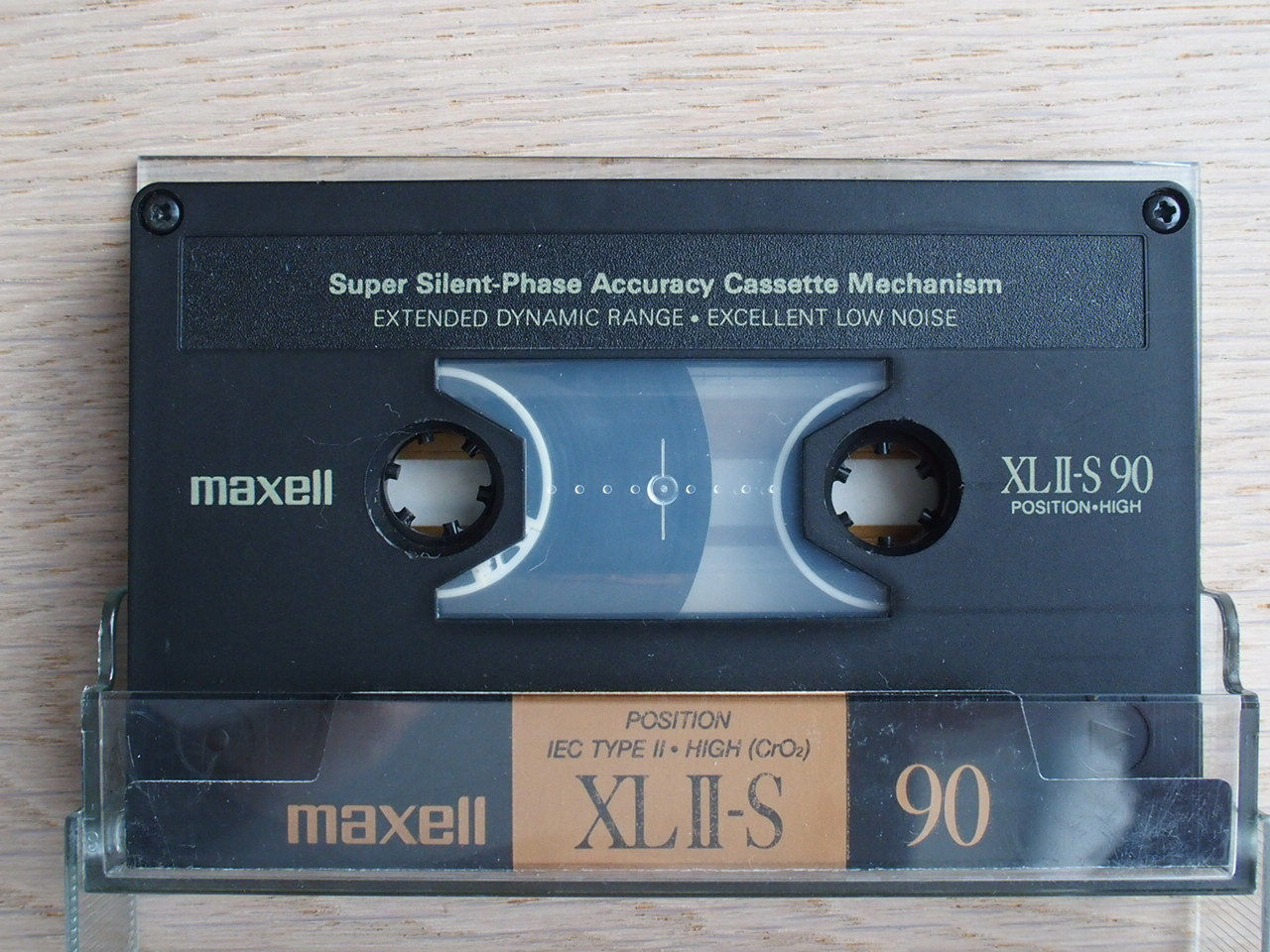
Relative bias: 0
Relative sensitivity: -0.1dB
THD @ Dolby level: 0.92%
MOL400(1%) : +0.3dB
MOL400(3%): +4.4dB
MOL1k(3%): +4.2dB
SOL10k: -3.5dB
Bias noise: -53.9dB, -58.0dB(A)
Dynamic range: 62.2dB

I never purchased these. I only recently got a few samples, most of them heavily used and worn. This is the best of the lot. Less strange compatibility parameters than 1986, at the cost of MOL and noise. Lower MOL, SOL, and noise than XLII, but the same dynamic range.


Maxell XLII-S (1991)

Relative bias: +0.5
Relative sensitivity: +0.6dB
THD @ Dolby level: 0.39%
MOL400(1%) : +3.2dB
MOL400(3%): +6.5dB
MOL1k(3%): +6.4dB
SOL10k: -2.7dB
Bias noise: -54.1dB, -58.3dB(A)
Dynamic range: 64.8dB

This is where Maxell dropped the 'Fine Epitaxial' marketing name in favour of 'Black Magnetite'.  A much better formula and almost a match for 1990 TDK SA-X, if you forgive it the bulged lower treble response.  Performance is virtually identical to 1993 BASF TPII. Indeed, BASF based their early TPII on Maxell pigment.


Maxell XLII-S (1994)

Relative bias: +2
Relative sensitivity: +0.6dB
THD @ Dolby level: 0.25%
MOL400(1%) : +4.5dB
MOL400(3%): > +7.0dB
MOL1k(3%): +6.5dB
SOL10k: -3.0dB
Bias noise: -54.3dB, -58.3dB(A)
Dynamic range: 65.3dB

This was my standard tape when I got my Nakamichi CR-2. Very low distortion at Dolby level.


Maxell XLII-S (1995)

Relative bias: +2
Relative sensitivity: +0.3dB
THD @ Dolby level: 0.34%
MOL400(1%) : +3.5dB
MOL400(3%): +7.0dB
MOL1k(3%): +6.1dB
SOL10k: -3.2dB
Bias noise: -53.9dB, -58.0dB(A)
Dynamic range: 65.0dB

The usual catalogueing websites tag this tape as 1998, but Hi-Fi Choice November 1995's tape special already features it.

The final chapter. I purchased lots of these, they were dirt cheap. Cassette was clearly in its decline. I virtually stopped taping at this time, so my stocks are still sealed. My older measurements with Cassette Deck 1 made it appear as if this tape was significantly lesser than the previous generation, but on the BX-300, and with my improved measurement routines, they are virtually identical.


Maxell XLII-S (1998, USA)

Relative bias: +3
Relative sensitivity: +0 dB
THD @ Dolby level: 0.23%
MOL400(1%) : +4.1dB
MOL400(3%): +6.9dB
MOL1k(3%): +6.5dB
SOL10k: -2.9dB
Bias noise: -54.5dB, -58.6dB(A)
Dynamic range: 65.5dB

The American version of the above tape, part of the 'man in the chair' series. It is usually put in 1998, but it may well have existed earlier. Essentially the same tape as before, with excellent performance.

This cassette (not mine!) was damaged in a spectacular accident involving a Nakamichi CR-3 and frying fat. Part got cut out, which is why the tape pack in the picture looks too small for a C-100.


Hitachi SX (1981)

 
Relative bias:-1.5
Relative sensitivity: +0.7dB
THD @ Dolby level: 0.85%
MOL400(1%) : +0.7dB
MOL400(3%): +5.0dB
MOL1k(3%): +5.0dB
SOL10k: -2.9dB
Bias noise: -51.1dB, -54.3dB(A)
Dynamic range: 59.3dB

I recently found ten of these, unsealed, but as a noise measurement testified, also unused. Nicely even tape packs, perfectly flat tape,  as if they were made yesterday. These are of course Maxells, sold under the name of their parent company. The box of the UD, the shell of the UDXLII, and the tape of the 1980 XLII-S. You can compare my measurements, or just look at the graphs on the j-cards. One thing is puzzling ... the typical Epitaxial smell is totally absent.


INDEX OF ALL CASSETTES

Cassette tape measurements: Maxell CR, XLII, Hitachi EX


Introduction

End of 2017 I purchased a good-condition Nakamichi Cassette Deck 1 (aka CD1), for no other reason than that I lusted after such machines back when I could not remotely afford them. I also always wanted to learn the real performance of the cassettes I so lovingly used in the 80s and 90s (first with a TEAC Black Plastic Cr*p deck, then with a CR-2), until CD-R and self-recorded DVD-A (yes!) wiped out everything. So in 2018 I embarked on a project of characterising all tapes I could lay my hands on. I did so first using the CD1, but after a while I changed over to a Nakamichi BX-300E, and I improved my measurement methods. You can find the details here.

This first series starts with my go-to tape of day one: Maxell's XLII.

The photographs are of the actual tapes used for the test, all purchased in Europe. Many of these cassettes are very old now. Most were mine, and have been well taken care of, others come from unknown sources and show some wear.

Click on the graphs for a larger version.


INDEX OF ALL CASSETTES


Maxell XLII (1994) (what the deck was calibrated for)

Relative bias: (reference)
Relative sensitivity: (reference)
THD @ Dolby level: 0.62%
MOL400(THD=1%) : +1.8dB
MOL400(THD=3%): +5.3dB
MOL1k(THD=3%): +5.5dB
SOL10k: -3.4dB
Bias noise: -54.8dB, -59.2dB(A)
Dynamic range: 64.5dB

I bought many of these at the end of my cassette era, shortly before moving over to DAT (an unwise decision that). Most of them remained unused or lightly used, so I chose them to be the standard type II tape to align to, for my own machines, as well as the decks that I refurbish and sell. (Later I switched to SXII, which is more robust and in line with IEC.)

Addition September 2019: and that was maybe not a wise choice. Contrary to some other generations this XLII diverges somewhat from the IEC II norm (U564W). In the meanwhile I have also looked at many more samples of these, and a great deal show a rising treble above and beyond what you see here. This may be a somewhat inconsistent tape; alternatively there may have been two different versions in its short life span, something hinted at in the 1994 and 1995 Hifi Choice cassette reviews you can download from this blog. I also found this XLII to be quite fragile: in their rush to ever lower bias noise levels the manufacturers, led by TDK, employed ever more aggressive polishing. This then led to long-term mechanical instabilities such as railroading or a high susceptibility to scratching.

All websites position this tape in 1994, but Hifi Choice January 1994 clearly states that it was launched Summer 1993, and that the actual tape in the months prior to this already had been loaded into 1991-type shells.


Maxell CR (1972)

Relative bias: -3.5
Relative sensitivity: -1.9
THD @ Dolby level: 2.6%
MOL400(1%) : -5.4dB
MOL400(3%): +1.0dB
MOL1k(3%): 0.0dB
SOL10k: -7.2dB
Bias noise: -53.9dB, -57.7dB(A)
Dynamic range: 58.7dB

Maxell launched its first chromium dioxide tape in 1971, and updated it in 1972 and then again in 1974. The tape itself was probably the same in all of these versions.

I was lucky to find this sample in decent condition at the end of 2025, and had to wonder where to put it. Eventually I decided on this page, as CR is the obvious predecessor of UDXLII. Compared to some of the very oldest chromes I tested performance is remarkably good.


Maxell UDXLII (1977)

Relative bias: -2.5
Relative sensitivity: +0.1dB
THD @ Dolby level: 1.7%
MOL400(1%) : -3.0dB
MOL400(3%): +2.6dB
MOL1k(3%): +2.4dB
SOL10k: -3.6dB
Bias noise: -52.7dB, -56.0dB(A)
Dynamic range: 58.6dB

Maxell's second ferro-cobalt 'epitaxial' tape (the first one was UDXL), and their first type II ferro-cobalt and foil to TDK's SA.

Beautiful, not? These were the first type IIs I bought in 1980 and I used them in an ITT portable. I had to ask my friends to record them for me on their parents' serious systems.

Bias had to be reduced a lot, yet sensitivity matches the more modern reference. There is 3.2dB more noise than the 1994 version, and MOL is 3dB lower. Together that gives a difference of 6dB in dynamic range. In other (simplistic) words: tape quality doubled in 24 years time.

It is interesting to compare with 1979 TDK SA. The Maxell has lower MOL but also lower noise. Moreover, there is a large difference in sensitivity between the two.


Maxell UDXLII (1980)

Relative bias: -2.5
Relative sensitivity: +0.0dB
THD @ Dolby level: 1.8%
MOL400(1%) : -2.8dB
MOL400(3%): +2.1dB
MOL1k(3%): +2.0dB
SOL10k: -3.3dB
Bias noise: -52.3dB, -55.7dB(A)
Dynamic range: 57.8dB

The first UD-XLII model was in 1980 replaced with a seemingly identical cassette,  but with a different wrapper (yellow replacing gold) and a less elaborate j-card (without the cutout). The actual tape appears to be still the same.


Maxell XLII (1982)

Relative bias: -2.5
Relative sensitivity: +1.2dB
THD at Dolby Level: 0.72%
MOL400(1%): +1.3dB
MOL400(3%): +5.2dB
MOL1k(3%): +4.9dB
SOL10k: -4.1dB
Bias noise: -52.2dB, -55.6dB(A)
Dynamic range: 60.8dB

These were the first tapes I bought in large quantities. By that time I had graduated to an ITT music centre (with metal, Dolby, and LED meters ;-).


Maxell XLII (1985)

Relative bias: -2.5
Relative sensitivity: 0dB
THD at Dolby Level: 1.5%
MOL400(1%): -1.2dB
MOL400(3%): +2.9dB
MOL1k(3%): +2.2dB
SOL10k: -3.9dB
Bias noise: -53.8dB, -57.8dB(A)
Dynamic range: 60.7dB


Maxell XLII (1986)

Relative bias: -1
Relative sensitivity: +0.5dB
THD at Dolby Level: 0.76%
MOL400(1%): +1.2dB
MOL400(3%): +5.2dB
MOL1k(3%): +5.0dB
SOL10k: -3.6dB
Bias noise: -53.0dB, -56.7dB(A)
Dynamic range: 61.9dB


Maxell XLII (1988)

Relative bias: 0
Relative sensitivity: +0.5dB
THD at Dolby Level: 0.69%
MOL400(1%): +1.6dB
MOL400(3%): +5.7dB
MOL1k(3%): +5.4dB
SOL10k: -2.6dB
Bias noise: -52.4dB, -56.4dB(A)
Dynamic range: 62.1dB


Maxell XLII (1990 JDM?)

Relative bias: -1
Relative sensitivity: +0.5dB
THD at Dolby Level: 0.72%
MOL400(1%): +1.4dB
MOL400(3%): +5.5dB
MOL1k(3%): +5.5dB
SOL10k: -3.1dB
Bias noise: -52.9dB, -56.5dB(A)
Dynamic range: 62.0dB

This cassette came without j-card. At first I though it was the 1991 USA variant. However, the highish noise is more in line with 1988 XLII, making this perhaps the 1990 Japanese domestic market type.


Maxell XLII (1991)

Relative bias: -1.5
Relative sensitivity: +0.4dB
THD at Dolby Level: 0.68%
MOL400(1%): +1.5dB
MOL400(3%): +5.1dB
MOL1k(3%): +5.0dB
SOL10k: -3.5dB
Bias noise: -54.6dB, -59.0dB(A)
Dynamic range: 64.1dB

This was the last epitaxial-based XLII, and seemingly the most IEC II compatible of the series.


Maxell XLII (1995)

Relative bias: -1
Relative sensitivity: +0.6dB
THD at Dolby Level: 0.4%
MOL400(1%): +3.0dB
MOL400(3%): +6.3dB
MOL1k(3%): +6.4dB
SOL10k: -4.2dB
Bias noise: -55.2dB, -59.6dB(A)
Dynamic range: 65.9dB

The usual catalogueing websites tag this tape as 1998, but Hi-Fi Choice November 1995's tape special already features it, as does Stereo's August 1995 issue. Therefore 1995 it is.

More IEC II-compliant than the previous version. Compared to 1994 the MOL and noise have improved, but SOL has suffered a bit. This gives a staggering 66dB of dynamic range, much like 1990 and 1992 TDK SA-X. But due to the lower SOL this can only be exploited with music without too much treble.

Around 2000 this model was replaced with one with identical looks, but a welded shell.


Maxell XLII (2002)

Relative bias: 0
Relative sensitivity: +0.2dB
THD at Dolby Level: 0.48%
MOL400(1%): +2.4dB
MOL400(3%): +6.0dB
MOL1k(3%): +5.8dB
SOL10k: -3.0dB
Bias noise: -54.6dB, -58.7dB(A)
Dynamic range: 64.7dB

The very last XLII. Not having a sample, this one confounded me for a while. So I purchased a few NOS ones. The wrapper makes one believe that there is a 1986-style shell in there, but it actually contains a 1998 shell in 1994 colour, with Peter Murphy in progress of being blown away.

I, however, was not. No matter where I measured on the tape, side A or B, beginning, middle, or end, in the BX-300 or in the CR-4, above 10kHz the left channel always lagged behind with 1 to 2dB. A second sample exhibited the same behaviour. Suspecting the shell I transplanted the tape to a 1990 SA, to no avail. Incidentally, this operation revealed that this version has a simpler slip sheet than the 1995 one.

Due to the compromised and variable treble performance finding the best operating point is not easy, and the same seems to have happened with the 1995 version, see above. This makes it hard to assess properly if the tapes themselves are identical between 1995 and 2002. The measurements are uncertain,  the colours match, the smells don't, 2002 is quite odourless. A bit of a mystery, and certainly a bit of a disappointment.


Hitachi EX (1981)

Relative bias: -2.5
Relative sensitivity: +0.3dB
THD at Dolby Level: 1.55%
MOL400(1%): -2.0dB
MOL400(3%): +2.6dB
MOL1k(3%): +2.2dB
SOL10k: -3.2dB
Bias noise: -52.1dB, -55.4dB(A)
Dynamic range: 58.0dB


Hitachi EX (1985)

Relative bias:-3.5
Relative sensitivity: +1.6dB
THD at Dolby Level: 0.85%
MOL400(1%): +0.9dB
MOL400(3%): +4.9dB
MOL1k(3%): +4.2dB
SOL10k: -4.1dB
Bias noise: -52.9dB, -56.3dB(A)
Dynamic range: 61.2dB

For this series Hitachi copied the livery of the 1980 XLII-S for all of their tapes, including this XLII-class EX. The usual websites put this EX in 1988, but German magazine Stereoplay reviews it in April 1985. There, as well as here, it tests very close to 1982 XLII.


INDEX OF ALL CASSETTES