13 August 2018

Cassette tape measurements: Maxell UDII, UDII-S, UDII-CD, SXII, GPXII, UDII-CD, USII, Capsule Cologne II, SQ


This is the sixth part of my cassette characterisation effort, looking at a few uncommon Maxell type IIs I have. For the full introduction and a description of the method please look here.

Click on the graphs for a larger version.


INDEX OF ALL CASSETTES


Maxell XLII (1994)  (my calibration reference)

Relative bias: (reference)
Relative sensitivity: (reference)
THD @ Dolby level: 0.62%
MOL400(THD=1%) : +1.8dB
MOL400(THD=3%): +5.3dB
MOL1k(THD=3%): +5.5dB
SOL10k: -3.4dB
Bias noise: -54.8dB, -59.2dB(A)
Dynamic range: 64.5dB

I repeat here the results for the tape my Nak BX-300E is calibrated for in type II position, the 1994 XLII. All following results take this as reference.


Maxell UDII (1984)

Relative bias: -2
Relative sensitivity: +0.5dB
THD @ Dolby level: 1.1%
MOL400(1%) : -0.1dB
MOL400(3%): +3.7dB
MOL1k(3%): +3.9dB
SOL10k: -4.2dB
Bias noise: -52.4dB, -55.8dB(A)
Dynamic range: 59.5dB

Maxell added a budget type II entry to their line-up in 1984. Vintagecassettes.com lists it for 1985, but the one sample I have was recorded end of 1984. I remember being disappointed with it (in my ITT ST20 music centre): it sounded dull. That made me ignore any successors of this tape.


Maxell UDII-S (1986)

Relative bias: -1
Relative sensitivity: +0.6dB
THD @ Dolby level: 0.66%
MOL400(1%) : +1.9dB
MOL400(3%): +5.9dB
MOL1k(3%): +5.4dB
SOL10k: -3.4dB
Bias noise: -52.1dB, -55.6dB(A)
Dynamic range: 61.5dB

A short-lived super version of the UDII, indeed vastly superior, and from the look of its performance figures the predecessor of the SXII.


Maxell SXII (1988)

Relative bias: -2
Relative sensitivity: +0.6dB
THD @ Dolby level: 0.67%
MOL400(1%) : +1.6dB
MOL400(3%): +5.4dB
MOL1k(3%): +5.4dB
SOL10k: -3.3dB
Bias noise: -53.2dB, -57.0dB(A)
Dynamic range: 62.4dB

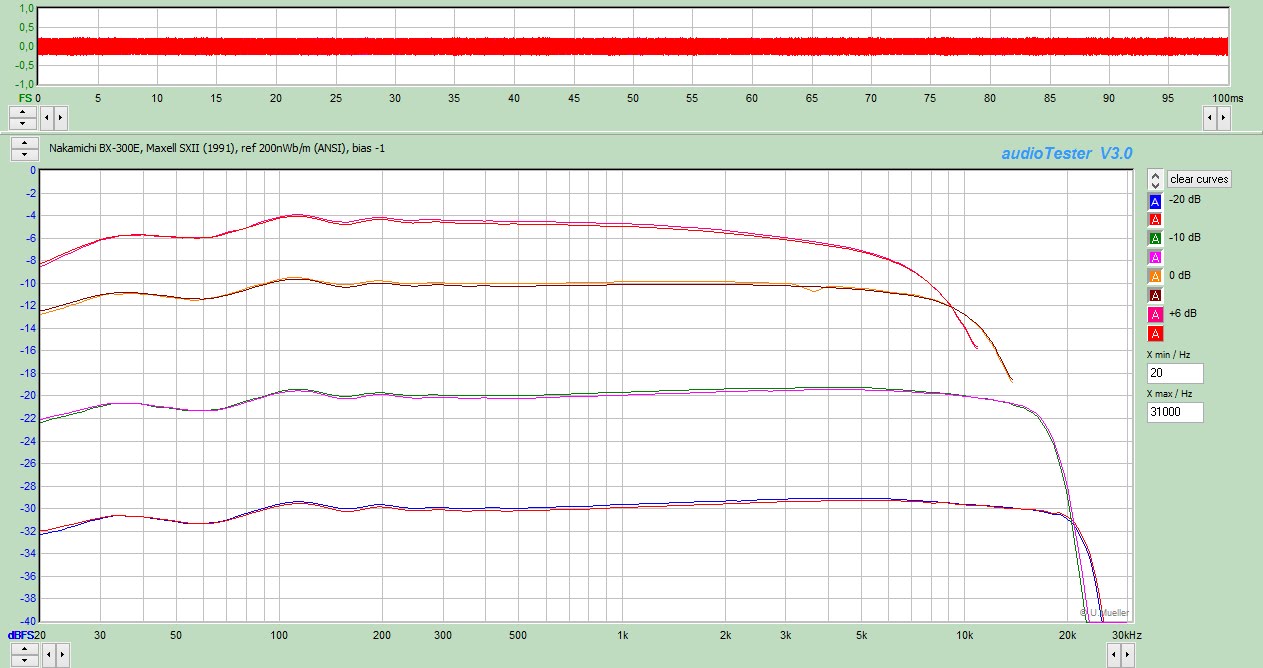
Despite having the house of the cheap UR, this tape seems quite excellent and is a serious improvement over the first UDII. Close to contemporary TDK SA, but slightly less sensitive.
The same tape in a better shell was sold under the name UDII.


Maxell SXII (1991)

Relative bias: -1
Relative sensitivity: +0.6dB
THD @ Dolby level: 0.50%
MOL400(1%) : +2.8dB
MOL400(3%): +6.4dB
MOL1k(3%): +5.8dB
SOL10k: -3.4dB
Bias noise: -54.0dB, -57.8dB(A)
Dynamic range: 64.2dB

In the original version of this article I did the testing with the Nakamichi Cassette Deck 1, and I measured less parameters. Back then I found no meaningful difference with the previous version of SXII. Now, with the new testing, it becomes clear that there were welcome gains in MOL and noise performance. Also note how distortion at Dolby level is less than with XLII! Once more, this tape is very close to TDK SA and the IEC II norm.


Maxell GPXII (1992)

Relative bias: 0
Relative sensitivity: +0.6dB
THD @ Dolby level: 0.55%
MOL400(1%) : +2.5dB
MOL400(3%): +6.3dB
MOL1k(3%): +5.6dB
SOL10k: -2.9dB
Bias noise: -53.9dB, -58.0dB(A)
Dynamic range: 64.3dB

GPXII was a short-lived rugged type aimed at car use. I don't know which tape was loaded. Apart from the optimal bias on the BX-300 it is very close to 1991 SXII. Perhaps it was an evolution of the latter?


Maxell UDII-CD (1995)

Relative bias: 0.5
Relative sensitivity: +0.2dB
THD @ Dolby level: 0.40%
MOL400(1%) : +2.8dB
MOL400(3%): +6.0dB
MOL1k(3%): +6.0dB
SOL10k: -2.8dB
Bias noise: -54.6dB, -58.7dB(A)
Dynamic range: 64.7dB

www.vintagecassettes.com puts this tape in 1996, but HiFi Choice reviews it already in February 1995, meaning that they must have had samples late in 1994. In that test UDII-CD behaves much like SA and the IEC II norm. Not my sample: this is more like 1994 XLII, especially if you know that I have found many XLIIs of that year requiring a bit more bias than the one I used as a reference.


Maxell UDII-CD (1998)

Relative bias: 0
Relative sensitivity: 0dB
THD @ Dolby level: 0.49%
MOL400(1%) : +2.0dB
MOL400(3%): +5.1dB
MOL1k(3%): +5.8dB
SOL10k: -3.0dB
Bias noise: -54.7dB, -58.9dB(A)
Dynamic range: 64.0dB


Maxell USII (1990, JDM)

Relative bias: -0.5
Relative sensitivity: +0.5dB
THD @ Dolby level: 0.52%
MOL400(1%) : +2.7dB
MOL400(3%): +6.3dB
MOL1k(3%): +5.8dB
SOL10k: -3.3dB
Bias noise: -54.2dB, -58.3dB(A)
Dynamic range: 64.6dB

A Japanese domestic market cassette apparently positioned below the UDII. The smoked clear shell with gold print is vaguely evocative of the Metal Vertex. The tape is very close to 1991 SXII and 1992 GPXII.


Maxell Capsule Cologne II (1990, JDM)

Relative bias: -1.5
Relative sensitivity: +0.8dB
THD @ Dolby level: 0.22%
MOL400(1%) : +2.0dB
MOL400(3%): +5.8dB
MOL1k(3%): +5.3dB
SOL10k: -3.3dB
Bias noise: -53.2dB, -57.2dB(A)
Dynamic range: 63.0dB

Probably the same tape as 1988 SXII.


Maxell SQ (2002)

Relative bias: +1.5
Relative sensitivity: -0.3dB
THD @ Dolby level: 0.97%
MOL400(1%) : +0.3dB
MOL400(3%): +4.5dB
MOL1k(3%): +5.2dB
SOL10k: -2.6dB
Bias noise: -52.6dB, -56.7dB(A)
Dynamic range: 61.2dB

Made by Saehan, sold through supermarkets. Allegedly there also existed a RAKS-made version of SQ.


INDEX OF ALL CASSETTES


11 June 2018

Cassette tape measurements: Maxell UD, UDI, UDI-S, UDI-CD, CD Capsule I, Hitachi UD


This continues my evaluation of old cassette tapes, using my Nakamichi BX-300E and Audiotester software. This time Maxell's UD line and derivatives. Hitachi-Maxell created 'Ultra Dynamic' as early as 1970. It was one of the very first cassettes aimed at quality music reproduction. It required a higher bias than Philips and the DIN norms prescribed and was probably instrumental in leading Japan away from the hobbling and Europe-dominated international standards. Most versions were based on gamma hematite, i.e. normal ferrics, but some of the later generations were cobalt-enriched.

For details on the measurement method look here.


INDEX OF ALL CASSETTES


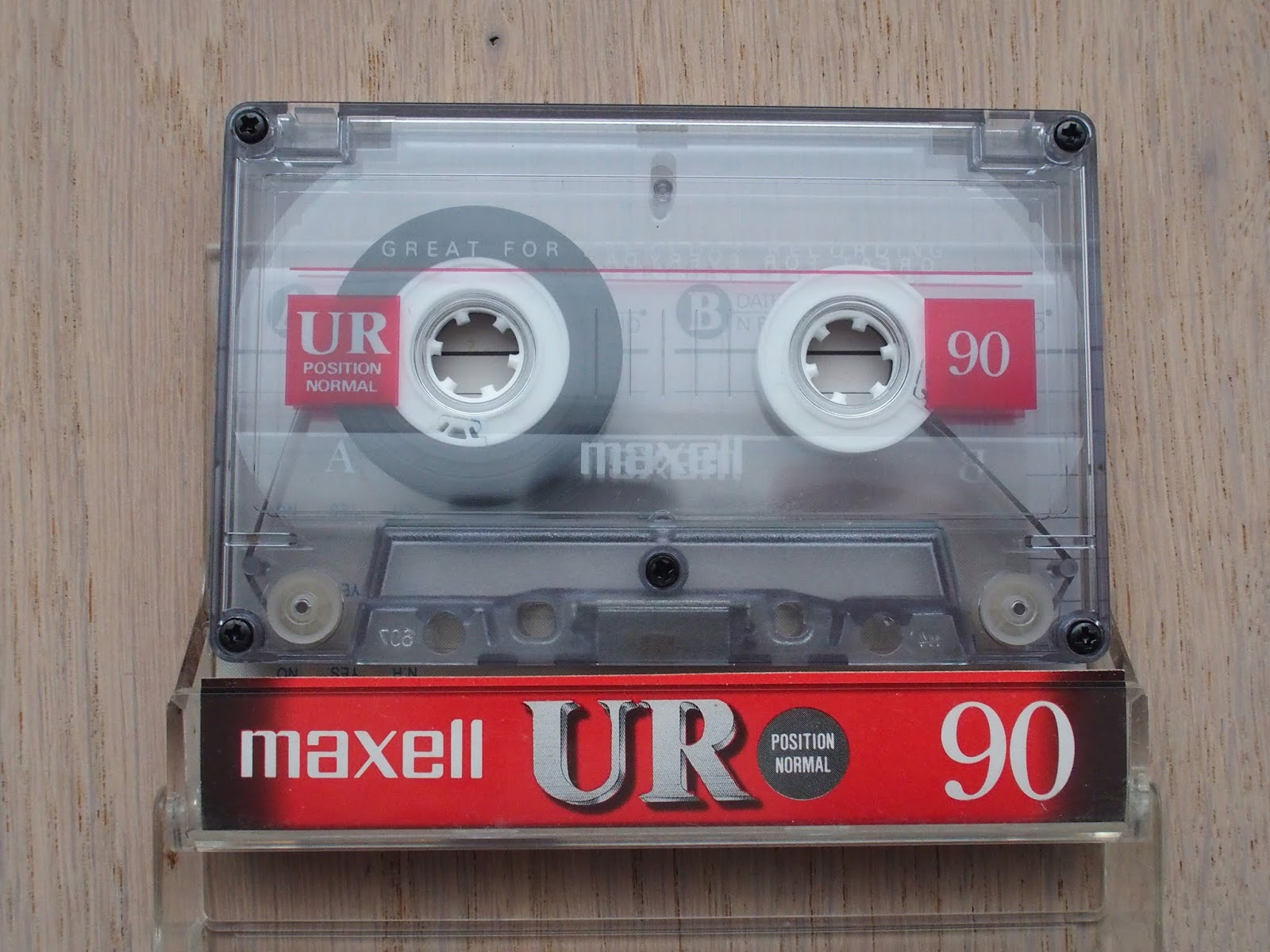
Maxell UR (1994)  (what the deck was calibrated for)

Relative bias: (reference)
Relative sensitivity: (reference)
THD @ Dolby level: 0.42%
MOL400(THD=1%): +3.4dB
MOL400(THD=3%): +5.3dB
MOL1k(THD=3%): +2.9dB
SOL10k: -1.3dB
Bias noise: -49.5dB, -52.5dB(A)
Dynamic range: 57.8dB


Maxell UD (1977)

Relative bias: -1
Relative sensitivity: 0.0dB
MOL400(3%): +4.3dB
Bias noise: -47.4dB, -50.4dB(A)
Dynamic range: 54.7dB

Maxell UD was born in 1970 and was one of the very first higher-quality tapes specifically meant for music. Its second version (1972?) was also sold as Nakamichi EX (first version). This here is the third version. I have one, it was my very first cassette, obtained as a birthday gift in October 1980. Despite being used heavily in a cheap radio cassette recorder it seems hardly worn. Observe how noise is even higher than of the contemporary UL (see here). The UD is only saved by a much higher MOL and flatter frequency curves.


Maxell UD (1980)

Relative bias: 0
Relative sensitivity: 0.0dB
MOL400(3%): +4.7dB
Bias noise: -50.2dB, -53.5dB(A)
Dynamic range: 58.2dB

Drastically improved noise. There are two versions of the jcard: one with 1980-style graphs, the other 1982-style. The shells are identical. I don't know if the tape itself changed in this period.


Maxell UDI (1984)

Relative bias: +1
Relative sensitivity: +0.6dB
THD @ Dolby level: 0.65%
MOL400(1%): +3.7dB
MOL400(3%): +7.0dB
MOL1k(3%): +3.3dB
SOL10k: -0.9dB
Bias noise: -49.5dB, -52.7dB(A)
Dynamic range: 59.7dB

These are excellent results, comparable with the 1985 TDK AD-X. However, I found that re-recording these cassettes nowadays is problematic: with some samples the first two minutes of each side sound heavily distorted. The cause seems to be mechanical stress imparted by the tape's connections to the hubs. Apart from 1982 XLI-S no other types in my collection exhibit this fault.


Maxell UDI-S (1986)

Relative bias:0
Relative sensitivity: +0.1dB
THD @ Dolby level: 0.55%
MOL400(1%): +2.2dB
MOL400(3%): +5.2dB
MOL1k(3%): +3.6dB
SOL10k: -1.2dB
Bias noise: -51.0dB, -54.0dB(A)
Dynamic range: 59.2dB

A very compatible tape, with a wide and smooth frequency response, and low noise.


Maxell UDI (1988)

Relative bias: +5
Relative sensitivity: +0.3dB
THD @ Dolby level: 0.53%
MOL400(1%): +3.5dB
MOL400(3%): +6.7dB
MOL1k(3%): +3.9dB
SOL10k: -0.7dB
Bias noise: -49.8dB, -53.4dB(A)
Dynamic range: 60.1dB

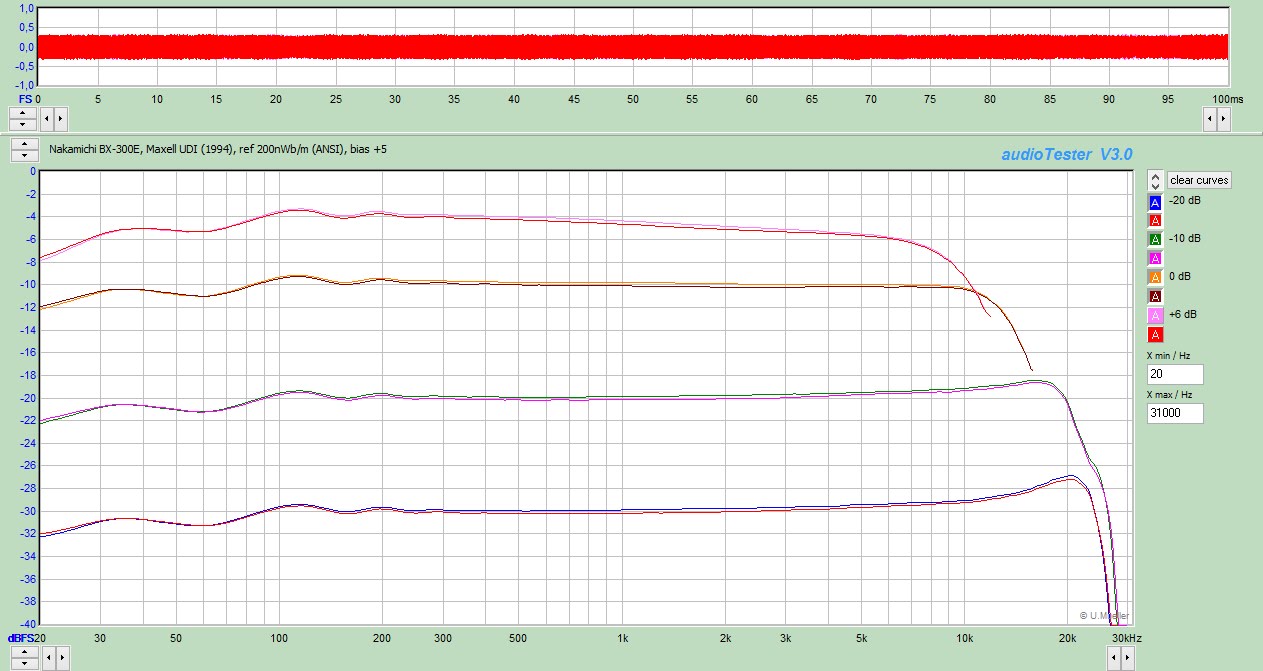
Suddenly things changed dramatically, with a massively increased need for bias. And this for a tiny benefit in noise over the older UDI. Allegedly this tape was also used in Agfa HR-S.


Maxell UDI-CD (1994)

Relative bias: +5
Relative sensitivity:  +0.1dB
THD @ Dolby level: 0.66%
MOL400(1%): +3.9dB
MOL400(3%): +6.9dB
MOL1k(3%): +4.3dB
SOL10k: -0.2dB
Bias noise: -50.2dB, -54.0dB(A)
Dynamic range: 60.9dB

The usual websites put this tape in 1996, but it appears in Hifi Choice February 1995, so it must have been available from 1994! Good performance, with improved noise, but like the previous UDI this tape demands an unusually high bias, even more than TDK AD 1988. In the above setup the tape is obviously still underbiased, but on my CR-7 this UDI-CD provides a ruler flat frequency response with -3dB at 25kHz, and +7.5dB and +6.8dB for the 400Hz and 1kHz MOL respectively!

Maxell UDI (1994, Japan)

Relative bias: +5
Relative sensitivity:  +0.1dB
THD @ Dolby level: 0.68%
MOL400(1%): +3.9dB
MOL400(3%): +7.0dB
MOL1k(3%): +4.8dB
SOL10k: +0.0dB
Bias noise: -50.7dB, -54.5dB(A)
Dynamic range: 61.5dB

Maxell's home market got to enjoy the UDI-CD tape in a slightly different shell in which the tape hubs and pack are referenced to the large central window (see comparison to UDI-CD below). Phenomenal magnetic performance, smooth winding, and excellent side A-B azimuth consistency. Incidentally, the shell is named 'Spintech' on some forums but, truly, 'Spintech' was the marketing name of the magnetic particle!

Maxell UDI (2000, Japan)

Relative bias: +5
Relative sensitivity:  +0.0dB
THD @ Dolby level: 0.40%
MOL400(1%): +3.3dB
MOL400(3%): +5.8dB
MOL1k(3%): +4.8dB
SOL10k: +0.2dB
Bias noise: -51.1dB, -54.8dB(A)
Dynamic range: 60.6dB

Fast forward to the next century. The snazzy, welded shell does not promise a lot, but it runs smooth enough, with good azimuth consistency. The tape differs from the earlier iterations, specifically in its distortion profile and MOLs. Noise is even lower than before. Overall still, surprisingly, an excellent product!

 Maxell CD Capsule I (1990, Japan)


Relative bias: +5
Relative sensitivity: +0.4dB
THD @ Dolby level: 0.62%
MOL400(THD=1%): +3.6dB
MOL400(THD=3%): +6.9dB
MOL1k(THD=3%): +5.0dB
SOL10k: -0.5dB
Bias noise: -50.0dB, -53.5dB(A)
Dynamic range: 60.4dB

A Japan-only series with a very wide range of playing times, perhaps to cater for every possible CD length? The tape appears to be 1988 UDI.


Hitachi UD (1977)

Relative bias: -1
Relative sensitivity: -0.1dB
THD @ Dolby level: 1.0%
MOL400(THD=1%): +0dB
MOL400(THD=3%): +3.2dB
MOL1k(THD=3%): +2.6dB
SOL10k: -2.2dB
Bias noise: -47.5dB, -50.5dB(A)
Dynamic range: 53.7dB

This tape should be identical to the 1977 Maxell UD tested above. While it certainly matches in its compatibility parameters and in noise, its MOL is a fair bit lower. Ageing or evolution? It might well be the latter, as my Maxell UD sample actually comes from 1980.


INDEX OF ALL CASSETTES