Even though Telefunken made legendary pro tape decks like the M15-series and the M20,
one would not immediately think of the company as a purveyor of
cassette decks. And yet, here is the RC300, the top model in the 1982
range, with two reasons for distinction: it had TFK's own High Com noise
reduction system (seemingly at the exclusion of Dolby B, but read on
...), and it was built around the mighty Papst
Multidrive. Papst already was deeply embedded in quality audio systems,
providing motors for Studer-Revox and other tape machines, as well as
for high-end turntables (Michell Engineering, Audio Note,
Wilson-Benesch, ...), even direct-drive modules for Dual. But the
Multidrive was a bit of a unique thing in the catalogue: a complete
cassette mechanism based on a single cast metal block, containing three
brushed direct-drive motors and one or two capstan flywheels. (How many all-direct-drive
cassette decks do you know?) The headgate was raised by means of a
twin-coil solenoid of serious proportions, resting between the two reel
hub motors, and lowered by a spring. It won't get any simpler than this
(simpler, not cheaper!), and people dreaming of the emergence of a
21st century quality tape drive would do well taking note of this
elegant and realisable architecture (then again, read on ...).
Multidrive was employed mainly by ASC and in this one Telefunken. It was also to be used in Dual's forthcoming C842RC
flagship, until that company's financial problems put paid to that,
resulting in the Japan-sourced C844 instead (followed with the fine
Sankyo-based C846 and CC1462).
So here we are: Telefunken RC300,
fully direct-drive, direct loading of the cassette, High Com, two heads,
and ... two speeds. Yes, like the Nakamichi 680: 4.76 cm/s as well as
2.38 cm/s!
RC300s are not particularly rare in Germany, and
reacting to a permanent query on kleinanziegen.de I could count myself
lucky in scoring one for a reasonable price, stated to be defective,
hoping for an easy fix and certainly not knowing that this was going to
be my longest restoration to date, december 2024 to october 2025!
Despite
minimal packing the deck arrived unscathed. After an internal
inspection I took my chances in powering it up. Some LEDs came on,
others remained dead, but (hurrah!) the level meters flashed all
of their segments (dead segments are a usual and irrepairable issue with
this model), no smoke escaped, no funny noises were heard. As expected
the mechanism itself remained lifeless.
The main cause was quickly found to be a blown fuse in the +15V supply, which was no cause for joy: why
did it blow? The mechanism was disassembled and inspected, then
lubricated. After putting it back together the tacho disk rubbed against
the motor coil PCB. Luckily the backside capstan bearing can be
adjusted, pushing the rotor towards the user, away from the coil. This
was successful insofar the deck now ran, albeit at lowish speed and with
high wow&flutter.
This is an old machine, with quite a few proprietary components.
Pre-dating the 230V era it seemed wise to add some protection for
over-voltage. First all AC-facing capacitors had their voltage rating
increased. I added a 150R 7W resistor in series with the mains inlet
(there is a very convenient place for this, but don't do so if you are
not formally qualified!). The LED level meters are a monolythic unit.
Individual LEDs often fail, in which case no replacement is possible. By
some stroke of mine were still fine. I protected the
meters by inserting a diode in their supply lines, reducing local power
dissipation. Finally the cassette well bulb was replaced with two green
LEDs in series, fed through a suitable resistor.
At this stage I was confident enough to operate the deck for longer periods of time.
This
quickly brought a new problem: during play the head gate dropped down,
while the reel motor kept pulling. A long analysis of the circuits,
taking measurements, ultimately concluded something was wrong in the
solenoid current source, a circuit including a string of diodes, one of
them inexplicably being a signal diode instead of the others (N4001s).
This got replaced with a power diode.
Back to testing
... Initially speed and wow&flutter were OK. To gain long-term
insight I usually log a few speed runs in WGFUI. Some of these now at
times showed a steady drop in speed over several minutes, followed with a
sudden return to normal. Still later sessions had less of this jerky
behaviour, but exhibited increasingly more wow&flutter. Probing
around in the motor controller circuit revealed voltages chaotically
jumping over many volts where slowly-changing DC is expected. The bottom
side of the motor (diode D705 and T716) showed a periodic voltage
remnant at ~30Hz, with 85% of the duty cycle seemingly normal, and 15%
pure noise. This stymied me for a while, but these noise bursts
ultimately gave a hint: it was as if the commutator only worked properly
for 85% of each rotation, or 6/7th. The commutator has 7 sections.
_speed_wf.png)
Opened
the transport again, and lo, the capstan motor commutator and brushes
were covered in a thin layer of black goo. My theory: the initial
rubbing of the tacho released rubber-like debris in the cavity, which
was caught by the commutator's lubricant, soiling the commutator and the
brushes, leading to increased and inconsistent contact resistance.
All
motors were properly cleaned, again, now with any lubrication left out,
after which all went back to normal. By the way, at this stage it was
clear that the three motors' tiny and thin brushes as well as the
fragile tacho magnet disc must be the weakest points of the mechanism:
prone to wear, and irreplaceable.


In
an attempt to debug the erratic speed controller I constructed a
breakout cable for the motor, allowing me to operate it on an external
power supply, while still keeping the tacho connected to the RC300's
circuits. Connecting the scope to the amplified tacho signal and to the
controller's output, I could observe proceedings. The raw motor appeared
to have poor speed stability, +/-15% , admittedly seen in unloaded
mode. The speed controller, then, showed frequent downward glitches on
its output, exceeding -5V. Clearly, the control loop bandwidth was
ludicrously wide, and its power supply rejection disappointingly low.
There were also 100Hz disturbances, originating in the raw 34V supply
used for kick-starting the head bridge solenoid.

The
motor controller design is overly complex, using something akin to
diode logic for implementing a zillion operating modes, each with its
own reel braking and tensioning regimes. It results in a supremely
smooth ride, but makes debugging hell. I gave up ... Really: I gave up.
Then
my long-standing internet search unearthed another RC300 in Germany,
this time with electronics problems, but, as the owner testified, "it
runs normally". Outwardly dirty and scratched it eventually proved
better than expected, but with one segment of the counter out of order,
and one channel playing 20dB low. The mechanism and head seemed healthy.
I labelled this machine '2', the other one obviously being '1'. After
bringing '2' into the same state as '1' it kept blowing its main fuse
whenever a cassette played for longer than 20 minutes or so. This took a
while to diagnose, along with a bag of fresh fuses, but one time I was
lucky enough to witness one blow, smoke rising from the fuse holder, and not the fuse itself. Thoroughly cleaning the holder's contacts put this issue to rest.
My
plan was to use '2' for debugging '1', then fixing both and selling
one. Surely making '1' go again with a perfectly-operating '2' literally
next to it, connected to the same measuring equipment, would be a
doddle, not?
Not. The speed controller remained a total mystery,
both machines behaving like different species, and no clue as to any
defective component in '1'.
So I started mixing up parts.
Mechanism '2' in deck '1' worked nicely... for a couple of hours. Then
it went erratic, too. Mechanism '1' in deck '2' also was no success. I
admitted defeat, abandoned deck '1' altogether, transplanting its
counter display, one High Com module, and the pristine face plate to
deck '2'. This provided me with a fully-functional machine, now with
decent speed stability.
I suspect that deck '1' has issues both in
the mechanism and in the speed controller. Of the latter I have no idea
at all (else I would fix it). As for the mechanism ... brush wear,
combined with superficial damage to the tacho disk?
The electrical design is idiosynchratic like none I've ever seen.
Type I playback uses 100us equalisation, where one would expect significantly higher
than 120us for the Alps sendust head (only heads with very small losses
operate well with the 'standard' 120us time constant). This is
reflected in a severely depressed high midrange and treble region when
reproducing the Hanspeter Roth 30Hz-18kHz playback response tape.
(Incidentally deck 1 and deck 2 gave the same result.)
_hpr_pb_response.png)
Recording
Type III, FeCr, is supported, but contrary to IEC III requirements uses
120us playback equalisation. The master record sensitivity is set for
type II, with fixed ratio attenuations for type IV and then for I
and III combined. Type II recording the loudest by design suggests that
this deck was made strictly with chromium dioxide in mind and not for
the, at that time more sensitive, ferro-cobalt types. The record
amplifier/equaliser is complex, but eq is not switched between
the four types. Apart from a very necessary switched treble boost for
half speed, there is only a small filling in of the mid-treble for type
III, compensating FeCr's typical depression in that area. You read it
well: the RC300 treats all tape types essentially the same in recording!
Doubting my eyes I looked into the Japan-built RC200's diagrams and
found the same remarkable philosophy.

Combined
with the aforementioned treble rolloff in playback this results in a
cassette deck that totally neglects all aspects of IEC standardisation
and inter-operability.
Bias is 85kHz: low for a deck claiming
20kHz record/playback capability. There are no real bias traps, only a
first order cut-off at 20kHz looking from the head into the record
amplifier. The meters go only to 2dB over Dolby level, forcing the user
to keep record levels down (and HighCom on). The meters are equalised,
though, showing the output of the record amplifier, including record eq
treble boost. (Strangely the RC200 goes to +6dB, but I am not convinced
it has a better head.)
As I planned on keeping this deck at least
for a while it had to be made compatible with modern-day recording, and
that means capable of playing back tapes made on my Nakamichis, and
recording with acceptable quality.
The first hurdle is of course
that debilitating playback treble loss due to the designers' cheating
with 100us, thus inflating the SNR figure in the leaflet. Assuming that
the Alps sendust head is not too dissimilar from the Canon sendust type
used in all (but one) 2-head Nakamichis since the BX-1 I focused on
reworking the PB eq to 150us. In fact, I used the PB amplifier response
of the CR-1 as a template, increasing both the time constant and the
treble peaking of the Telefunken until the latter's circuit response
almost matched the Nak's. (The picture below shows a modified left
channel response next to the original right channel.)
_Roth_pb_fixed.png)
With
the entire treble area thus raised this resulted of course in
treble-heavy and unbalanced rec/play curves: the inverse correction
curve had to be applied to the record equalisers. A -3dB treble shelf
was added to the record gain alignment circuit, and the latter was
reworked to offer maximum gain with metal tape. This required that the
control signal for transistor T1308 was moved from Metal to CrO2. The
resistor values were adapted to provide a reasonable sensitivity match
for Sony Metal XR 1989 or 1995 (also many Maxell MX), Maxell SXII 1991
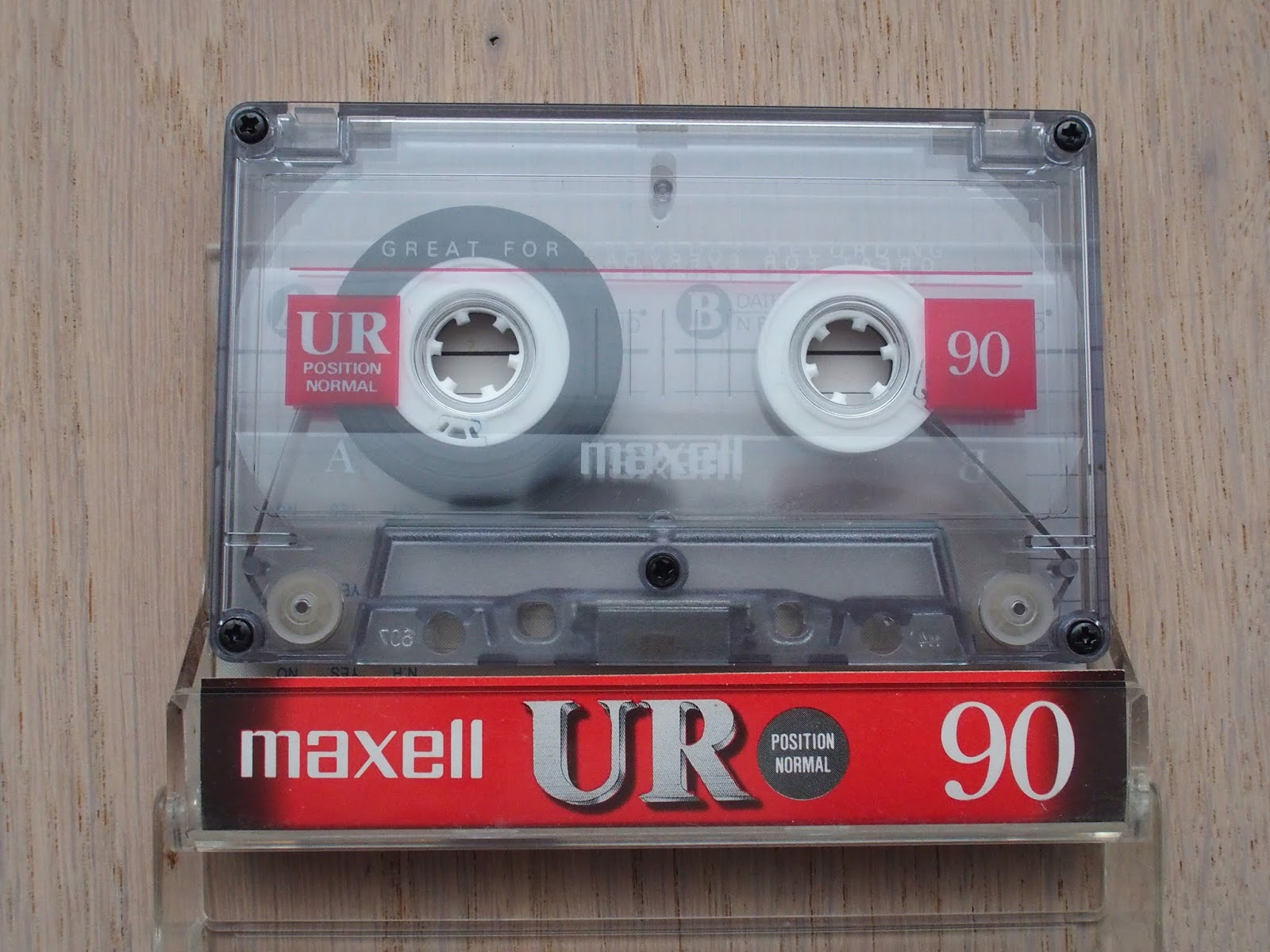
(close to SA and IEC II reference U564W), Maxell UR 1994. Ultimately I
made the alignment around SXII.
The type III record equalisation
network was defeated, and its bias trimmer expanded to allow less bias.
Thus the FeCr position was converted into an extra type I selection,
intended to be set to a higher bias for tapes like Maxell UDI-CD.
Even
so the final recording performance was not to write home about. Maxell
SXII gave quite flat rec/play curves extending to 19kHz at -20dB and
10kHz at 0dB, yes, but MOL was a paltry 1.5dB above Dolby level. UR
managed +3.2dB, and UDI-CD in its special slot even +5dB, but the
responses were channel-imbalanced and with a significant plateau in the
high midrange and low treble. Metal type showing an opposite channel
imbalance I did not even bother with it. After all who would use a deck
with low MOL and inadequate metering to record onto metal tape?
(As usual for two-headers: most sweeps started at 200Hz for easier synchronisation in audioTester.)
In
a way a pitty, because Telefunken's reasoning was that for the
low-speed mode type IV would be used. That now being impossible I
reverted to SXII to test this deck's mettle when hamstrung. This gave a
frequency response out to 11.5kHz at -20dB and 5kHz at 0dB. Not that one
would want to record that high, because MOL had dropped to -1.5dB! Then
again, Telefunken's continuing reasoning went that HighCom be used, of
course.

Part
of the mediocre headroom of this deck has its cause in the record and
playback electronics. As mentioned before, these are overly complex due
to the need to switch equaliser segments for four tape tapes, two
speeds, and cue/review in and out of circuit. This is done with standard
BJTs as opposed to more specialised devices, resulting in a great deal
of even order distortion, on top of the head/tape-caused odd order
distortion. Maybe the deck can be improved somewhat by removing all
unwanted functionality, and replacing the remaining switches with
something more suitable. But I won't go there...
Telefunken
gambled heavily on High Com, but as totally neglecting Dolby B would be
commercial suicide early HC-equipped decks sported a 'D NR Expander'
button (the 'D' styled as in the Dolby logo), said to offer
Dolby-compatible playback decoding. It was quickly found that with the
addition of some signal switching the High Com circuit could be made
into a Dolby-like encoder, and this functionality was added to
later Telefunken decks, including the RC300. This was not exactly
advertised, except for a dry "In der Schalterstellung D NR Expander
koennen auch Aufnahmen gemacht werden". To show that this was for real I
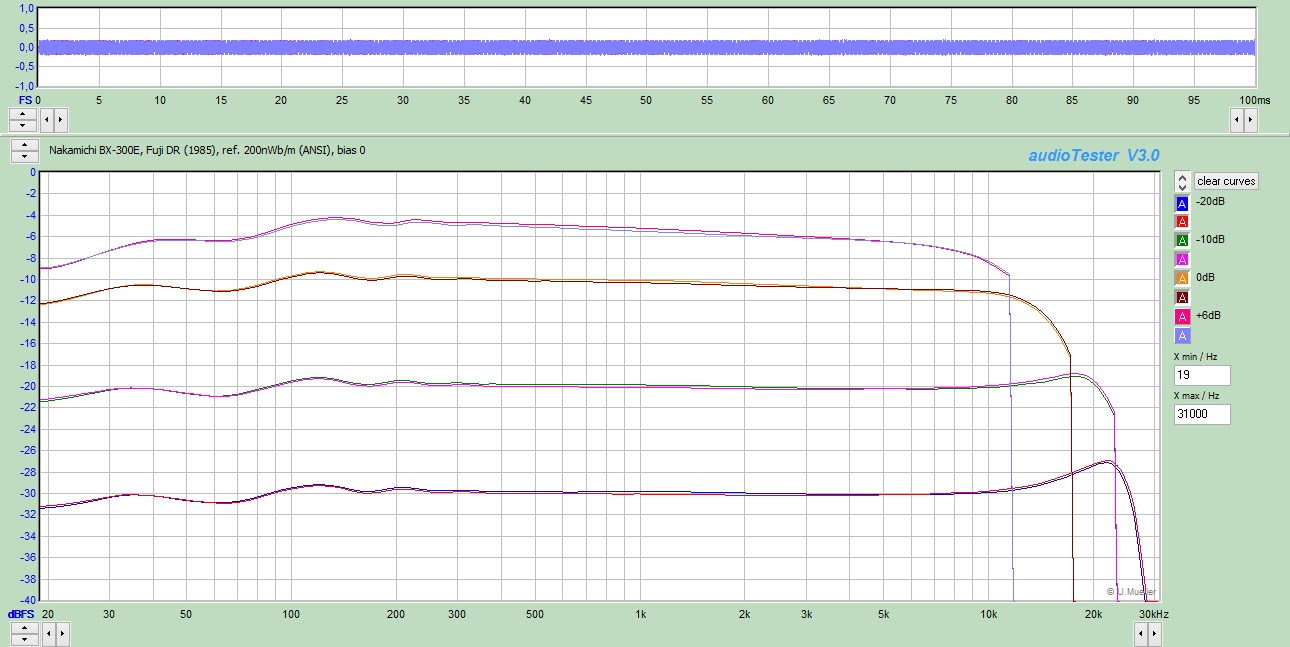
recorded white noise at four levels with "D NR" on, and replayed them
with "D NR" off, while graphing the responses:
Playback of tapes recorded on my CR-7 or CR-4, no noise reduction, is quite good, with decent space and detail. Tonally the bass is a bit odd. Commercial prerecordeds fare less well: with D NR enabled they are dull, and with pumping effects.
Record/play performance at both speeds, on Maxell SXII, with an without High Com you can assess yourself with this MP3 download
Keep in mind that this deck, with its modified equalisers, can no longer be regarded as representative for what Telefunken intended. I hope to bring deck '1' in a fully working and original state (except for the horrific speed stability) to find out how that one sounds.