Luck brought me another golden-age deck equipped with a Sankyo direct-drive mechanism, 1982's Sansui D-570. Originally silver, the previous owner had spray-painted it black with extreme prejudice. I suppose it had to match Darth Vader's system.
It took me ages, and frozen fingers, in our wintery garage to remove all that darkness. Applying cellulose thinner to the metal front was successful in that it, with effort, stripped off the paint while not attacking the silk screening or transparent window. The same thinner was used sparingly on the plastic escutcheon carrying the transport keys, but here the plastic got a 'dirty' aspect, while the legends faded. Finally all of the buttons and keys and the cassette door were soaked for weeks in isopropanol, then wiped off with rags and a magic eraser sponge. Again, success on the buttons, but the door also lost part of its original silver paint in the process. Oh well ...

The mechanism is an evolution of the 1981 Onkyo TA-2060: idler reel drive, solenoid control, and electro-magnetic brakes and back-tension are the same, but the bulky brushed capstan motor got replaced with the brushless design that would later appear in so many direct-drive decks. Transports don't get much simpler than this. All it needed was cleaning, lubricating, a new back-tension belt and ilder tyre. The reel motor pulley was not even cracked. The deck responded to this care with excellent speed stability, a perfectly acceptable 0.055% wow&flutter (weighted RMS), and a stable 50g.cm reel torque.


The deck is easy to work on, once you grasp that the mechanism has to be removed through the front. The boards are accessible from both sides, but the fold-up Dolby board cannot stand on its own, a nuisance. The circuit diagrams are confusing, with the same component names often re-used elsewhere, even on the same board! The PCBs neatly indicate the main functional blocks, but the components themselves are not marked or even outlined on the solder side. As usually I replaced the main supply capacitors. The signal paths contain large quantities of elcaps: I left these alone, replacing them all with Nichicon Muse or Elna Silmic would deplete my dwindling stock too much, and replacing only a few would be pointless.

The heads are Hitachi, both record and play sections being ferrite and housed in a casing that makes them look like one single head. Late-70s, early-80s magazine reviews already remarked that these heads' profiles are sub-optimal, imposing playback frequency response irregularities ('woodles', 'contour effects') that ripple from the deep bass not just up to a few 100Hz, as is quite normal, but up to a few kHz. In fact, the rec/play frequency response never quietens down! Luckily these old magazines also seemed to agree that the subjective effect of these anomalies were minimal. (For another class of decks marred by oddball head profiling look at the Akai GX-32 and 52!).
Apart from these ripples the playback from the Hanspeter Roth 30Hz-18kHz response tape was remarkably flat. Remarkable because most decks of this era, Nakamichi excluded, tended to have a drooping or shelved-down response. Not this Sansui: it complied perfectly with the IEC 1981 standard! And even better, azimuth was nicely in accordance with my A.N.T.Audio and HPR tapes.
The same response ripples obviously manifest in the record/play frequency sweeps, also characterised by a plateauing treble above 3kHz and a seemingly untameable high treble. Then I remembered an old review of a Hitachi deck commenting that the combo head allowed a great deal of crosstalk from the record section to the playback section during recording. And yes indeed: playing the recorded frequency sweep again after rewinding instead of during recording resulted in a flatter curve with less extension. To be kept in mind when calibrating.
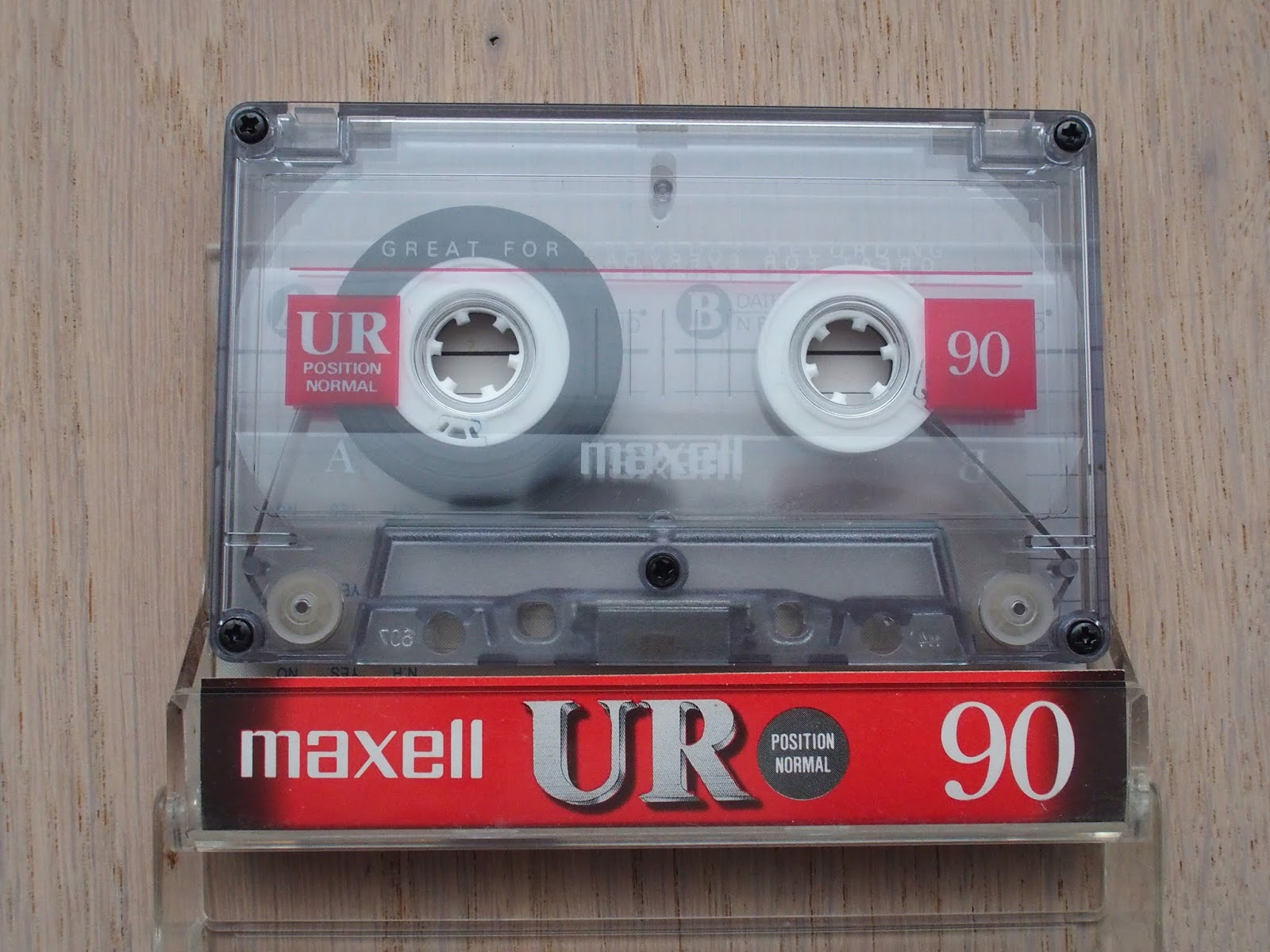
The D-570 has only one set of bias and level calibration trimmers. As always I calibrated to Maxell SXII 1991, a sturdy tape that is close to TDK SA and IEC U564W, and then found the following responses for UR 1994 and TDK MA 1988. (Keep in mind that the entire area above 3kHz is artificially lifted and ragged by that head crosstalk.)
When fuly aligned for SXII, UR was 0.7dB up in LF sensitivity and even more in the treble. This was easily redressed by putting 27k resistors in parallel to jR4 and jR5. Metal sensitivity was only -0.3dB with MA, so no further modification needed.
The associated MOLs at 400Hz for 3% THD and relative to Dolby level were +3.9dB (UR), +4.7dB (SXII), +5.3 (MA), all solid figures. Playback noise (from a bulk-erased Chrome Maxima) was -60.3dB(A) ref. Dolby, 1 or 2dB higher than ideal. Bias noise for the SXII was -57.4dB(A), only slightly above what I get on my Nak BX-300. Unweighted noise levels were somewhat worse than expected, pointing at the presence of slight hum components.
This Sansui has a bias fine knob with a calibration assist based on comparing 1kHz and 10kHz tones, 3 LEDs on the front indicating FM-tuner-wise when both are at the same level. I found this system's window of acceptance rather wide for type II, and stupidly so for type I: use it as a rough guide only, then proceed adjusting bias by ear. And remember that due to the in-head crosstalk mentioned above the deck will sound a bit too bright when recording in tape monitor mode.
Another oddity is the early Dolby C implementation that relies on a total of 8 NE645N Dolby B chips. Despite there being additional adjustment points on the Dolby board, tracking in 'C' mode is far from perfect, significantly exaggerating the deck's innate response aberrations. This translates into audible brightness and sizzle. However, a useful trick is to first calibrate without Dolby with the test tones and by listening, then turning the bias knob up to a quarter turn further clockwise for a flatter response with Dolby C.
Overall this is an interesting deck, if somewhat idiosyncratic, but sounding better than its measurements would want you to believe.